
NewsNEWCENTER
Featured products
Contact Us
Why Choosing the Right LED Supplier Matters for B2B Success
2025-06-04For B2B buyers (wholesalers, distributors, project contractors, or e-commerce sellers), sourcing high-quality LED lights is not just about product performance—it directly impacts your profit margins, customer trust, and project success. The global LED market is flooded with suppliers, but many offer inconsistent quality, fake certifications, or delayed deliveries.
Whether you’re looking for commercial LED lighting, industrial high bay lights, or automotive LED headlights, finding a reliable B2B LED supplier requires more than just comparing prices. This guide breaks down 7 non-negotiable criteria, practical sourcing channels, and risk-avoidance tips tailored for international B2B buyers, helping you partner with a supplier that meets your quality, compliance, and scalability needs.
I. Clarify Your B2B Sourcing Needs First
Before starting your search, define these 3 core requirements to narrow down candidates efficiently:
- Product Type & Application Scenarios: Are you sourcing commercial linear lights for offices, IP68 waterproof LED lights for outdoor projects, or automotive LED headlights for aftermarket sales? Different scenarios demand specific parameters (e.g., UGR < 19 for anti-glare office lighting, DLC/UL certification for North American markets).
- Order Scale & Customization Needs: Do you need bulk orders (1000+ units), small-batch trials, or OEM/ODM customization (e.g., logo printing, color temperature adjustment)? Clarify MOQ (Minimum Order Quantity) and customization lead time expectations upfront.
- Compliance & Logistics Requirements: Which regional certifications are mandatory (CE for Europe, DOT for the US, PSE for Japan)? Do you need support with international shipping, customs clearance, or overseas warehouse delivery?
II. 4 High-Efficiency Channels to Find B2B LED Suppliers
1. B2B Platforms (Precise Matching for Global Sourcing)
Top platforms like Alibaba, Made-in-China, or Global Sources aggregate thousands of LED suppliers. Use combination keywords to filter accurately:
- “DLC certified LED panel light supplier”
- “IP67 industrial LED high bay light manufacturer”
- “Automotive LED headlight supplier with E-Mark certification”
Focus on suppliers with verified factory profiles, on-site audits, and positive buyer reviews to avoid “trade companies posing as manufacturers.”
2. Industry Trade Shows (On-Site Verification of Strength)
Attend global lighting trade shows to meet suppliers face-to-face:
- Light+Building (Frankfurt)
- Lighting Fair International (LFI, USA)
- Guangzhou International Lighting Exhibition (GILE)
On-site, you can test product samples (e.g., brightness, heat dissipation), inspect manufacturing processes, and negotiate cooperation terms directly—this is the most effective way to avoid “online-offline inconsistency” risks.
3. Search Engine Sourcing (Find Direct Manufacturers)
Use Google/Bing with long-tail keywords to target source factories:
- “Shenzhen LED light manufacturer for commercial projects”
- “Reliable LED work light supplier with ISO9001 certification”
- “B2B LED supplier offering OEM service for European markets”
Prioritize suppliers with official websites ranking on the first page—they usually have stronger brand awareness and SEO optimization capabilities, indicating better market competitiveness.
4. Peer Recommendations & Industry Communities
Ask fellow B2B buyers (e.g., distributors in your region, project contractors) for referrals. Reputable LED suppliers often gain clients through word-of-mouth, and peer feedback can reveal critical details:
- How fast is the after-sales response?
- Do they deliver on time as promised?
- Are the product parameters consistent with the datasheet?
Join industry forums (e.g., Lighting Manufacturers Community) or LinkedIn groups to exchange supplier reviews and sourcing experiences.
III. 7 Non-Negotiable Criteria for Choosing a B2B LED Supplier
1. Authentic Certifications & Compliance
Compliance is make-or-break for international B2B sales. A reliable supplier must hold valid regional certifications:
- Global: ISO9001 (quality management system), IP Rating (waterproof/dustproof)
- Europe: CE, E-Mark, RoHS
- North America: DLC, UL, ETL, DOT
- Asia: PSE (Japan), CCC (China), KC (South Korea)
Request original certification documents and verify them on official databases (e.g., UL’s Product iQ) to avoid fake certificates.
2. Proven Product Quality & Technical Data
B2B buyers need tangible evidence of quality, not just marketing claims:
- Ask for detailed datasheets including lumen output, CRI (Color Rendering Index), CCT (Correlated Color Temperature), and lifespan test reports.
- Request samples for on-site testing: Check light uniformity, heat dissipation (temperature ≤ 90℃ after 20 hours of use), and durability.
- Focus on core components: Reputable suppliers use brand LED chips (Cree, Bridgelux) and drivers (Meanwell) for stable performance.
3. Manufacturing Capacity & Supply Chain Stability
Avoid supply chain disruptions with these checks:
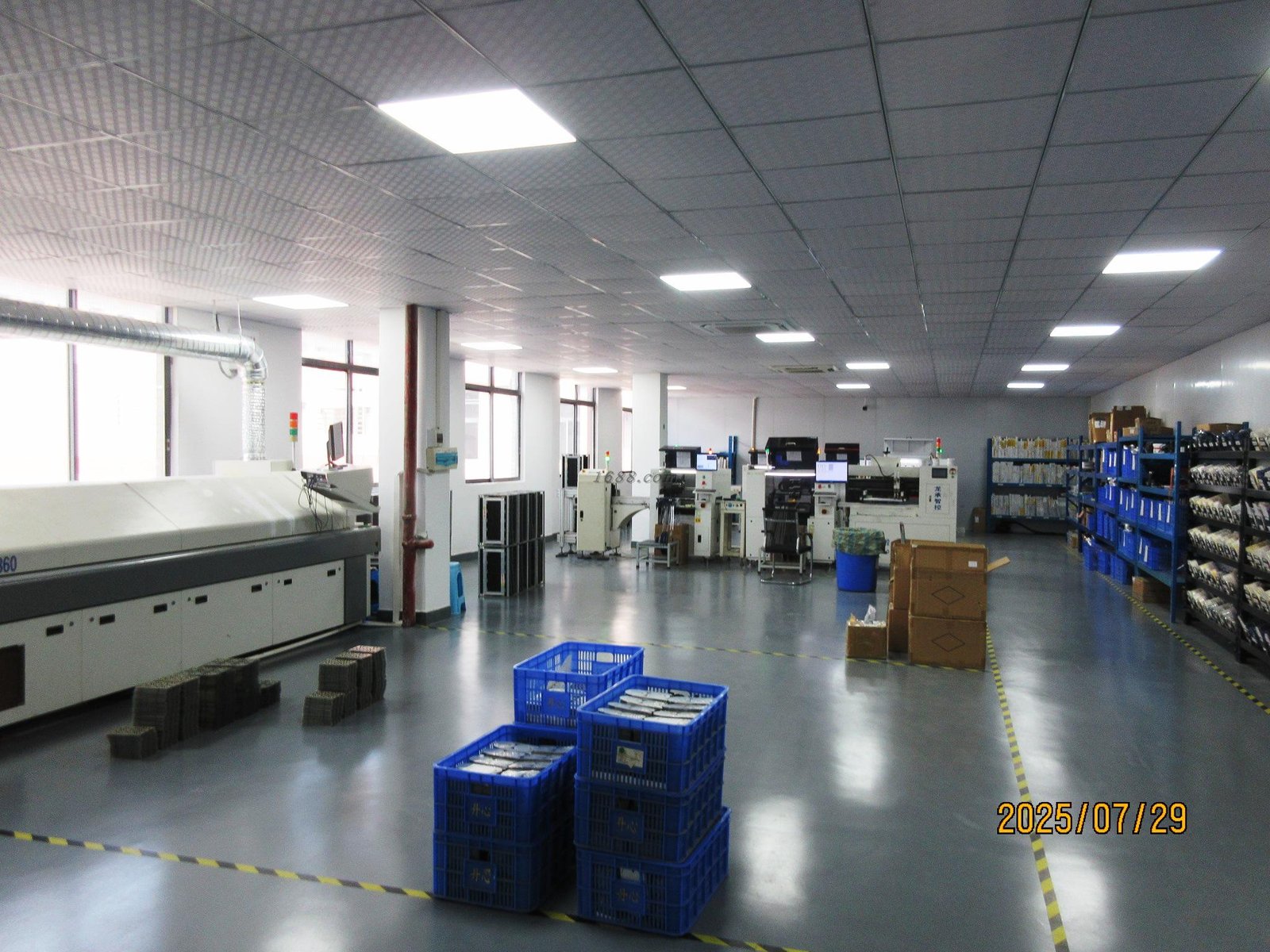
- Verify factory scale: Do they have their own production lines, SMT workshops, or aging test labs? Ask for factory videos or on-site audit opportunities.
- Confirm production capacity: Can they handle your peak-season orders? What’s the lead time for bulk orders (ideally 3-7 days for standard products)?
- Assess raw material sourcing: Do they have stable suppliers for LED chips and drivers to avoid price fluctuations or shortages?
4. Customization & Technical Support
B2B LED sourcing often requires customization. A good supplier should offer:
- OEM/ODM capabilities: Design adjustment, mold development, and custom packaging.
- Professional technical support: Lighting layout suggestions, installation guides, and troubleshooting for project-specific needs.
- Access to technical documents: IES files, CAD drawings, and installation manuals for your clients.
5. Transparent Pricing & No Hidden Costs
Beware of “low-price traps”—unrealistically low quotes often mean cutting corners on materials or hiding fees:
- Ask for a detailed price breakdown (raw materials, production, packaging, certification costs).
- Confirm payment terms (e.g., 30% deposit, 70% against B/L copy) and currency options (USD/EUR).
- Clarify additional fees: Customization charges, expedited production fees, or logistics costs.
6. Reliable After-Sales & Warranty Policy
B2B LED products require long-term warranty support. Look for:
- A minimum 1-3 year warranty (industry standard for high-quality LED lights).
- Clear after-sales procedures: How to handle defective products (replacement or refund)? What’s the response time for complaints (ideally 24-48 hours)?
- Global after-sales network: For large-scale projects, do they have local service partners to provide on-site support?
7. Cross-Border Logistics & Documentation Support
International B2B sourcing relies on smooth logistics and compliant documentation:
- Confirm logistics options: Do they cooperate with reliable freight forwarders (DHL, FedEx, or sea freight for bulk orders)? Can they provide door-to-door service?
- Ensure complete documentation: Commercial invoice, packing list, certificate of origin, and certification copies for customs clearance.
- Support for overseas warehouses: Do they offer storage and fulfillment services in key markets (e.g., US, EU) to reduce delivery time?
IV. 3 Common Risks to Avoid When Sourcing B2B LED Lights
1. Fake Certifications & Misrepresented Parameters
- Never trust screenshots of certifications—request original files and verify via official channels.
- Test samples with third-party labs if needed, especially for high-value orders, to confirm lumen output, lifespan, and waterproof performance.
2. Unstable Supply Chains & Delayed Deliveries
- Avoid suppliers with unclear factory information or those refusing on-site visits.
- Sign a detailed contract specifying delivery dates, penalty clauses for delays, and quality standards.
- Start with a small trial order to test their production capacity and delivery speed before scaling up.
3. Poor After-Sales & No Technical Support
- Reject suppliers that offer no warranty or vague after-sales policies.
- Confirm technical support availability: Do they have English-speaking engineers to assist with installation or troubleshooting?
V. Recommended Reliable B2B LED Supplier: Tenraytech
If you’re looking for a one-stop B2B LED supplier that meets all the above criteria, Tenraytech is your trusted partner (Official Website: https://tenraytech.com/). As a professional LED lighting manufacturer with 10+ years of experience in global B2B sales, we offer:
- Full Product Range: Covering commercial lighting (linear lights, panel lights), industrial lighting (high bay lights, work lights), automotive LED headlights, and outdoor waterproof LED lights.
- Global Compliance: All products are certified with CE, E-Mark, DLC, UL, and IP67/IP68 ratings, meeting regional standards for Europe, North America, Asia, and beyond.
- Strong Production Capacity: Own 3 automated production lines with a daily output of 10,000+ units, supporting MOQ 100+ and OEM/ODM customization (lead time 15-30 days).
- End-to-End Support: 24/7 English technical support, 3-year warranty, global logistics integration, and overseas warehouse delivery in the US/EU.
- Proven Track Record: Partnered with 500+ B2B buyers in 60+ countries, with successful cases in office buildings, industrial workshops, and automotive aftermarket projects.
Conclusion: Partner with the Right Supplier for Long-Term B2B Success
Finding a reliable B2B LED supplier is about balancing quality, compliance, and service—not just chasing the lowest price. By following the 7 criteria in this guide, using targeted sourcing channels, and avoiding common risks, you can build a stable supply chain that drives your business growth.
Ready to source high-quality LED lights for your B2B business? Visit Tenraytech’s official website to:
- Download product datasheets and certification files
- Request free samples for testing
- Get a customized quote based on your order scale
- Contact our B2B sales team for one-on-one support
Copyright @ 2026 Tenraytech | Global Wholesale Automotive LED Lighting