
NewsNEWCENTER
Featured products
Contact Us
From Sample to Mass Production: LED OEM/ODM Workflow for International B2B
2025-08-09For B2B buyers (brands, distributors, cross-border e-commerce sellers) targeting global markets, the core pain points of LED OEM/ODM customization are not only product quality but also process connection and risk control “from sample to mass production.” Compliance requirements in different countries, complex cross-border logistics, and quality stability in bulk production—every step determines the success of the order.
Tailored specifically for international B2B buyers, this guide fully breaks down the entire LED OEM/ODM workflow from demand docking and sample confirmation to mass production and delivery. It clarifies core tasks, risk-avoidance tips, and Tenraytech’s one-stop support solutions at each stage, helping you smoothly advance customization projects and quickly seize the global LED lighting market.
I. Preparations: 3 Core Questions to Clarify Before Customization
Before officially launching the customization process, clarifying the following requirements can significantly reduce subsequent communication costs and rework risks:
1. Market & Compliance Requirements
- Lock in target markets: Specify regions where products will be sold (e.g., Europe, the US, Southeast Asia) to match corresponding certifications (CE/E-Mark for Europe, UL/DLC for the US, PSE for Japan);
- Confirm compliance details: Whether it is necessary to meet RoHS environmental standards and energy efficiency indicators (e.g., DLC energy-saving certification for North America) to avoid customs clearance delays due to lack of certifications.
2. Product & Customization Requirements
- Define product type: Automotive LED headlights, industrial high bay lights, commercial linear lights, or outdoor waterproof lights;
- Refine core parameters: Brightness (luminous flux), color temperature (3000K-6000K), IP rating (waterproof/dustproof), service life, etc.;
- Customization needs: Appearance design (e.g., housing color, size), function upgrades (e.g., multi-mode dimming), brand integration (logo printing, custom packaging).
3. Order & Cooperation Requirements
- Determine order scale: Small-batch trial orders (100-500 units), bulk mass production (1000+ units), and clarify Minimum Order Quantity (MOQ) expectations;
- Discuss cooperation terms: Delivery cycle, payment method (e.g., 30% deposit + 70% against B/L copy), after-sales warranty requirements (1-3 years).
II. Core Workflow: 6 Key Stages From Sample to Mass Production
Stage 1: Demand Docking & Program Evaluation (1-3 Working Days)
- Buyer provides detailed demand documents: Including product drawings (OEM mode), parameter lists, customization requirements, and target market information;
- Manufacturer (Tenraytech) responds:
- The technical team conducts feasibility analysis to determine if product design and parameters meet production standards and market compliance requirements;
- Provides a detailed quotation: Clarifies sample fee, mold development fee (if applicable), mass production unit price, MOQ, and delivery cycle;
- Outputs customization plan: ODM mode offers suggestions for modifying existing products; OEM mode provides design optimization solutions (e.g., structural adjustments, material selection);
- Sign cooperation agreement: Both parties confirm the plan, price, and terms, and sign a formal contract to protect rights and interests.
Stage 2: R&D Sampling & Sample Confirmation (7-15 Working Days)
- Sample production:
- OEM mode: The manufacturer develops molds based on the buyer’s drawings (mold development cycle: 7-10 days), purchases core components (LED chips, drivers), and completes sample assembly and testing;
- ODM mode: Modifies custom details (e.g., adding logos, adjusting color temperature) based on mature models to quickly produce samples (3-5 days);
- Sample testing: The manufacturer tests core indicators of the sample (brightness, heat dissipation, waterproof performance, service life) and provides a test report;
- Buyer confirmation: After receiving the sample, the buyer conducts on-site testing (e.g., installation compatibility, light effect experience), provides revision feedback, and the manufacturer iterates and optimizes until the sample is qualified (usually 1-2 rounds of revisions).
Stage 3: Pre-Production Preparation & Material Procurement (5-10 Working Days)
- Confirm production plan: The manufacturer formulates a production schedule and reserves production lines based on order quantity and delivery date;
- Material procurement & inspection: Purchases raw materials according to sample standards (ensuring core components such as LED chips and drivers are consistent with the sample) and conducts 100% quality inspection before warehousing to avoid product quality issues caused by material problems;
- Custom packaging preparation: Designs packaging according to the buyer’s requirements (printing brand logos, product parameters, certification marks) and completes packaging sampling and confirmation.
Stage 4: Mass Production & Process Control (7-20 Working Days, adjusted by order quantity)
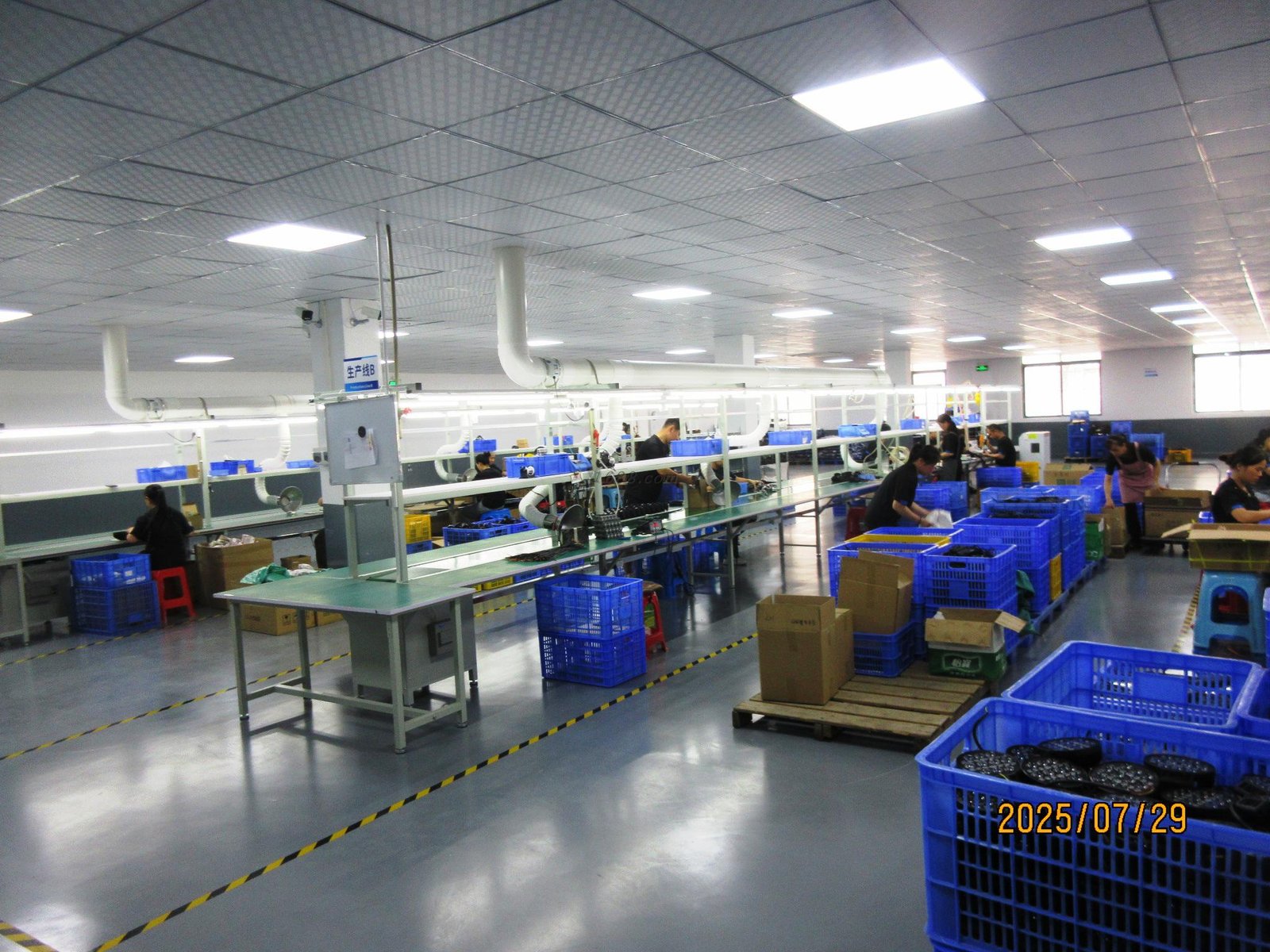
- Automated production: Adopts SMT chip mounting and automated assembly lines to improve production efficiency and consistency;
- Key process inspection:
- Semi-finished product inspection: Conducts circuit testing and light effect detection on soldered and assembled semi-finished products to eliminate defective products;
- Aging test: All products are lit for 24 hours for aging testing to ensure service life and stability;
- Finished product 100% inspection: Conducts full inspection of brightness, color temperature, waterproof performance, and appearance, and issues a quality inspection report;
- Buyer supervision (optional): Supports on-site supervision by buyers or third-party institutions to track production progress and quality in real time.
Stage 5: Packaging, Warehousing & Logistics Arrangement (3-7 Working Days)
- Finished product packaging: Packages products according to custom packaging requirements, attaches logistics labels and certification marks to ensure transportation safety;
- Inventory management: Qualified finished products are warehoused and managed systematically to avoid mixed batches and incorrect shipments;
- Cross-border logistics solutions:
- Logistics methods: Provides sea freight (bulk orders), air freight (urgent orders), and express delivery (small-batch trial orders) based on order quantity and delivery needs;
- Customs clearance support: Prepares complete customs clearance documents (commercial invoice, packing list, certificate of origin, certification copies) to assist buyers in smooth customs clearance;
- Overseas warehouse service: Supports inventory in US and European overseas warehouses to shorten end-delivery time.
Stage 6: After-Sales Support & Long-Term Cooperation
- Logistics tracking: Real-time updates of logistics information and assistance in handling abnormal transportation situations (e.g., cargo detention);
- After-sales support: Provides a 3-year warranty service, free replacement or refund for quality issues; 24/7 technical consultation to solve installation and usage problems;
- Order review: After bulk delivery, communicates product market feedback with buyers, optimizes subsequent production and customization plans, and establishes a long-term cooperation mechanism.
III. Risk-Avoidance Guide for International B2B Customization: 4 Core Risk Controls
1. Inconsistent Quality Between Samples and Mass Production
- Avoidance tips: Sign a quality agreement to clarify consistency requirements between samples and mass-produced products; require the manufacturer to provide inspection reports for “the first batch of mass-produced products” and compare them with sample parameters; arrange 1-2 on-site inspections during mass production if conditions permit.
2. Lack of Certifications or Fake Certifications
- Avoidance tips: Clarify target market certification requirements before customization; ask the manufacturer to provide original certifications and verify them through official databases; specify in the contract that “the manufacturer shall bear all losses caused by customs clearance failure due to certification issues.”
3. Delivery Delays & Logistics Risks
- Avoidance tips: Clearly stipulate delivery cycles and delay penalty clauses in the contract; confirm the manufacturer’s production schedule and raw material inventory in advance; choose manufacturers with cross-border logistics experience to avoid risks such as customs detention and cargo damage.
4. Customization Deviations Due to Communication Misunderstandings
- Avoidance tips: All customization requirements (e.g., appearance, parameters, packaging) shall be based on written documents (drawings, confirmation forms); sign and file important milestones (sample confirmation, packaging confirmation) with both parties; use bilingual communication (Chinese and English) to avoid language ambiguity.
IV. Tenraytech: A Reliable Partner for International B2B LED OEM/ODM Customization
As a source manufacturer with over 10 years of experience in the LED lighting industry, Tenraytech (Official Website: https://tenraytech.com/) specializes in providing one-stop customization services “from sample to mass production” for global B2B buyers. Its core advantages directly address international procurement pain points:
- Efficient and Controllable Processes: Sampling cycle as short as 7 days, mass production cycle of 7-20 days, full-process visual tracking to ensure on-time delivery;
- Global Compliance Guarantee: All products have passed CE, E-Mark, UL, DLC, and IP67/IP68 certifications, adapting to markets in over 60 countries for worry-free customs clearance;
- Strict Quality Control: 6 quality inspection processes from raw material procurement to finished product delivery; 100% consistency guarantee between samples and mass-produced products, supporting third-party testing;
- Comprehensive Cross-Border Services: Cooperates with well-known freight forwarders such as DHL and FedEx to provide integrated logistics solutions (sea/air/express); inventory in US and European overseas warehouses to reduce logistics costs and time-sensitive risks;
- Rich Customization Experience: Has served over 500 international B2B buyers with mature customization cases in the automotive aftermarket, industrial lighting, and commercial lighting fields, enabling rapid adaptation to different market needs.
Conclusion: Choose the Right Process to Make LED Customization a Market Competitiveness
The core of international B2B LED OEM/ODM customization lies in “clear requirements + standardized processes + reliable partners.” Standardizing and controlling every link from sample to mass production can avoid risks, reduce costs, and make customized products a “weapon” for exploring global markets.
With mature customization processes, strict quality control, and comprehensive cross-border services, Tenraytech has become a long-term partner for many global B2B buyers. If you are looking for an efficient and reliable LED OEM/ODM customization manufacturer, welcome to visit the official website (https://tenraytech.com/) to contact the sales team, obtain free customization plans and quotes, and start your global LED market expansion journey!
Copyright @ 2026 Tenraytech | Global Wholesale Automotive LED Lighting